
Clothing sales: when they arrive and how to tell if a discount is worth it
Sales follow the seasons and a few fixed dates. Here is their calendar, and five checks to judge a discount before you pay.
 Team Tidf
Editorial team
- Published
Clothing sales do not arrive by surprise. They follow the seasons and a few dates that come back every year. Knowing when they come gives you time. Knowing how to read a discount gives you judgement. This guide covers both.
When the sales arrive
A clothes shop buys by season. What does not sell takes up the room the next season needs. That is why the big sale comes while the season is still running, not once the cold or the heat is over.
The two clearances of each year
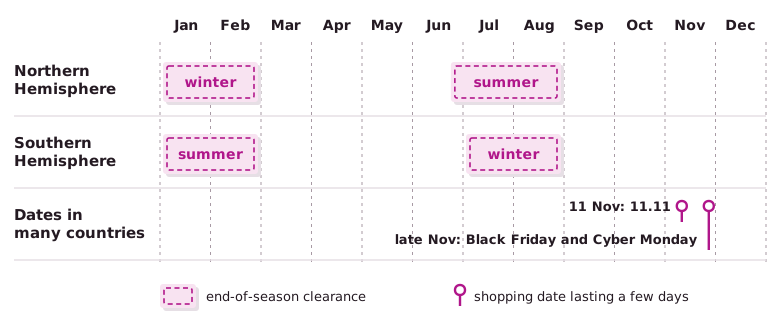
The usual pattern is two big clearances a year: one in winter and one in summer. The month depends on the hemisphere.
- Northern Hemisphere. The winter one starts around January. The summer one, at the end of June or in July. In Spain, for example, the Inditex chains opened their 2026 summer sales on 24 June in their app and on 25 June in their shops (Merca2, 3 June 2026).
- Southern Hemisphere. The seasons run the other way round. In January, summer clothes are cleared, and in July and August, winter clothes. In Argentina, Zara opened a clearance of its spring and summer season in January 2026, with discounts of “up to 60% on various selected items” (iProfesional, 14 January 2026).
January and July are sale months in both hemispheres. What changes is the clothing being cleared. A trade source quoted by iProfesional summed it up like this: “All over the world, July is now a clearance month” (iProfesional, 15 July 2024).
The exact date changes with the shop and with the country. To find yours, look at the website or the app of the shop where you buy.
Other dates in the year
Between one clearance and the next there are more discounts. Each one works differently.
| Type of sale | When it usually arrives | What you usually find |
|---|---|---|
| Seasonal clearance | January and July, depending on the hemisphere | Lots of clothing from the current season, with discounts that grow every week |
| Mid-season | Halfway through a season, before its clearance | Short discounts on part of the collection |
| Black Friday and Cyber Monday | End of November | Discounts of a few days, in shops and online |
| 11.11 | 11 November | Discounts from online shops, above all from large platforms |
| Early access | Hours or a day before a clearance | The same sales, earlier, for people who use the shop’s app or get its emails |
| Outlet | All year round | Clothing from past seasons, in fewer sizes and colours |
Black Friday and Cyber Monday were born in the United States, and today shops in many countries hold them. 11.11 began in 2009 as an online shopping day of Alibaba Group, in China, and today many online shops use it (Alibaba Group, 2017).
How a clearance moves
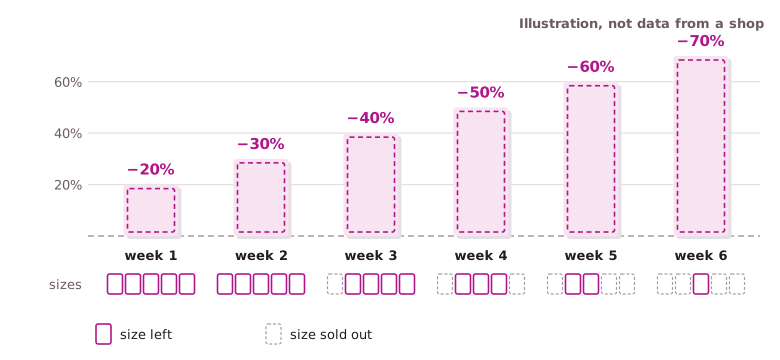
A clearance is not the same on its first day as on its last. At the start, the discount is smaller and almost every size is still on the rail. As the weeks go by, the discount grows and the sizes run out. Clearance pricing models describe it this way: higher prices at the start and deeper markdowns at the end, when less of the assortment is left (Smith and Achabal, 1998).
What to do with that:
- If you are after a specific garment in your size, go in early. You pay a little more, but you find it.
- If several styles or colours would do, wait for the second or third markdown. The discount is bigger; the choice, smaller.
- If your size has gone, do not take another one. A garment that does not fit you well does not get worn, however low its price.
Five checks before you pay
A big percentage does not tell you whether the purchase is good. These five questions do help.
1. Where does the crossed-out price come from?
The crossed-out price is the one the shop says it had before. It is not always the one most people paid.
An example from another kind of product shows it well. The British consumer organisation Which? followed 227 Black Friday deals from 2023 at eight big home and tech retailers. 92% were the same price or cheaper at other times of the year. In six out of ten, the “was” price had applied for less than half of the previous year (Which?, 26 November 2024). It is a single country and it is not clothing, but the lesson holds all the same:
- Note the price before the sales. A note or a screenshot of what you like is enough.
- Compare with that price, not with the crossed-out one. What you pay is what counts.
- Look for the same garment in another shop that sells it. With the style’s reference number, it usually turns up.
2. “Up to 70%” is not “70%”
“Up to” marks the maximum. That discount is usually on a few garments, sometimes in odd sizes. Look at the percentage on the tag of the garment in your hand.
3. Chained discounts do not add up
A “30% + an extra 20%” is not 50%. The second discount applies to the price that has already been cut.
| What the shop advertises | What you pay out of every 100 | Real discount |
|---|---|---|
| 30% + an extra 20% | 100 × 0.70 × 0.80 = 56 | 44% |
| 50% + an extra 10% | 100 × 0.50 × 0.90 = 45 | 55% |
| 40% + an extra 40% | 100 × 0.60 × 0.60 = 36 | 64% |
To work it out, multiply what you pay at each step: 70% of the price, and then 80% of that. With your phone’s calculator it takes three seconds.
4. Count the wears, not the percentage
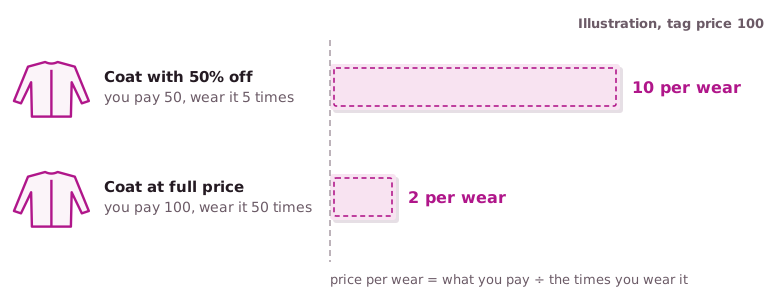
A discounted garment you do not wear is not cheap. Divide what you pay by the number of times you think you will wear it. That is its price per wear.
5. Check the garment as you would on any other day
Sale stock has been in the shop for weeks, and many hands have tried it on. Before you pay:
- Seams and fastenings. Pull gently on the side seams. Try the zip and make sure no button is missing.
- Rubbing and snags. On fine knits, silk and linen, snags and marks show sooner. On denim and heavy cotton they hardly show, so look at them in good light.
- Collar and cuffs. They are the first to show wear when a garment is tried on a lot.
- The composition and care label. If it asks for hand washing or dry cleaning, count on that work every time it needs washing. In wool and silk garments it is common; in cotton and polyester, rare.
Hurry is not a discount
Countdowns, notices that only a few units are left, sales that end “in a few hours”. The OECD calls this urgency: a limit of time or quantity, real or not, that pushes you to decide fast (OECD, 2022).
A countdown does not change what the garment is worth. If you need it and it passes your five checks, go ahead. If not, let it go. Another clearance comes in six months.
A discount is worth it when the garment is useful to you, the price is real and you are going to wear it.
Your list for the next clearance
- Before: go through your wardrobe and write down what you really lack.
- Before: note your size in the shops where you usually buy. Each brand measures differently.
- Before: save the price of what you are interested in.
- On the first day: look for what is on your list, in your size.
- The following weeks: go back only if another style or another colour would do.
- At the till: work out the chained discount and the price per wear.
- At home: try it on with what you already have, within the return period.
Quick questions
Is it better to buy on the first day or to wait?
It depends on what you are looking for. If it is a specific garment in your size, the first day. If several would do, waiting usually brings a bigger discount and less to choose from.
Is a bigger markdown always a better buy?
No. 70% off something you do not wear costs more, per wear, than 20% off something you will wear every week.
Are sale clothes of lower quality?
There is no fixed rule. Check the composition, the seams and the fastenings just as you would at full price.
Are online sales different from those in the shop?
They usually start at the same time, or a few hours earlier online. Look in both places: a size sold out in the shop may still be on the website, or the other way round.
Sources
- Smith, S. A. and Achabal, D. D. (1998). “Clearance Pricing and Inventory Policies for Retail Chains”. Management Science, 44(3), 285–300. doi.org/10.1287/mnsc.44.3.285
- OECD (2022). Dark commercial patterns. OECD Digital Economy Papers, No. 336. doi.org/10.1787/44f5e846-en
- Which? (26 November 2024). “Nine in 10 Black Friday deals cheaper or same price at other times of the year”.
- Merca2 (3 June 2026). “Inditex confirma la fecha de las rebajas de verano 2026” [Inditex confirms the date of its 2026 summer sales]. In Spanish.
- iProfesional (14 January 2026). “Zara lanza liquidación en Argentina con descuentos de hasta 60 % en indumentaria” [Zara launches a clearance in Argentina with discounts of up to 60% on clothing]. In Spanish.
- iProfesional (15 July 2024). “Inédito: ya liquidan ropa de invierno pese al frío polar extremo” [Unprecedented: winter clothes already on clearance despite the extreme polar cold]. In Spanish.
- Alibaba Group (2017). 11.11 Global Shopping Festival: fact sheet.