Search
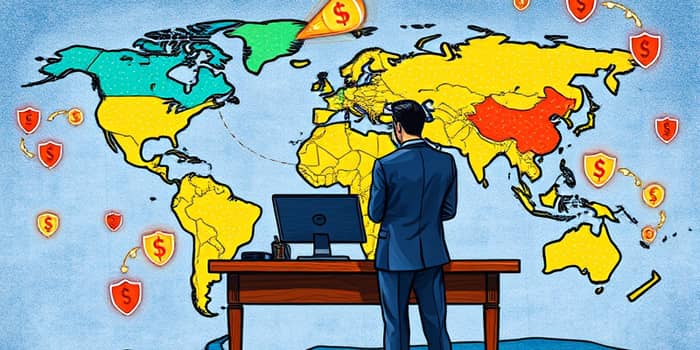
In today’s interconnected financial landscape, extending credit across national borders offers immense opportunity—and profound challenge. From New York to Nairobi, financial teams grapple with amplified risks beyond domestic scenarios, balancing growth ambitions against potential volatility. This article guides CFOs, risk officers, and policy makers through the nuances of currency and political risk, offering practical strategies to transform uncertainty into strategic advantage.
Through real-world examples, empirical evidence, and clear frameworks, we illuminate how lenders can build resilience and sustain cross-border flows even in turbulent times.
Cross-border lending inherently exposes institutions to two principal hazards. First, currency risk—where sharp movements in exchange rates erode repayment values and trigger funding gaps. Second, political risk—emanating from sanctions, regulatory shifts, or geopolitical tensions that can halt or reroute capital flows.
Facing both simultaneously demands a cohesive approach that integrates market insights, robust data, and adaptive structures.
At its core, currency risk arises when lenders hold exposures in foreign denominations without perfect hedges. sharp exchange rate fluctuations can slash the real value of repayments, leaving a lender short of its funding obligations. Consider the Euro/USD pair, which can swing nearly 20% over a year, compelling suppliers to inflate dollar prices accordingly.
Key drivers of currency risk include:
Financial institutions often deploy on-balance sheet derivatives to reduce mismatches, yet over 20% of exposures remain in major currencies booked in regions with capital controls. This gap creates foreign currency liquidity stress when markets seize up, heightening rollover risk and funding shortfalls.
Political risk can manifest as policy shifts, sanctions, or outright conflict—each capable of disrupting repayment flows and undermining contract enforceability. From UN voting disagreements to targeted sanctions, lenders must quantify changes in cross-border lending capacity and collateral values.
Below is a summary of political risk impacts on lending:
Financial institutions with strong capital bases demonstrate greater resilience, highlighting the critical role of capitalization in buffering against political turbulence.
Proactive mitigation transforms risk from a threat into a controllable element of strategy. Leading institutions employ a combination of hedging, contractual design, and data-driven monitoring to safeguard portfolios.
To further strengthen resilience, many firms embed macroprudential buffers and stress tests into their frameworks, ensuring that currency mismatches and political shocks are captured in scenario analyses.
Historical case studies, such as the Crimea annexation in 2014 and the Russia–Ukraine conflict in 2022, offer quasi-experimental insights. In both episodes, cross-border lending to affected regions plummeted, while local affiliate operations persisted—underscoring the value of decentralized funding sources.
Research also shows that verified credit data can reduce cross-border default rates to below domestic norms. Institutions leveraging verified credit data cuts default have experienced fewer surprise write-offs, reinforcing the importance of transparent information sharing.
For CFOs and risk officers, the path forward involves continuous refinement of both market and political intelligence. Embrace the myth-busting reality that cross-border exposures, when managed with rigor, can outperform domestic portfolios in stability.
Regulators can foster resilience by enhancing cross-border coordination, harmonizing disclosure standards, and implementing liquidity rules tied to foreign currency holdings.
Ultimately, maintain local affiliate lending during global stress periods and cultivate strong bilateral ties—through diplomatic engagement and trade partnerships—to shore up credibility and reduce funding costs.
By weaving together advanced analytics, strategic contracting, and robust governance, financial leaders can convert volatility into opportunity. Let this comprehensive guide inspire you to fortify your cross-border lending operations, safeguard capital, and propel sustainable growth across jurisdictions.
References