Search
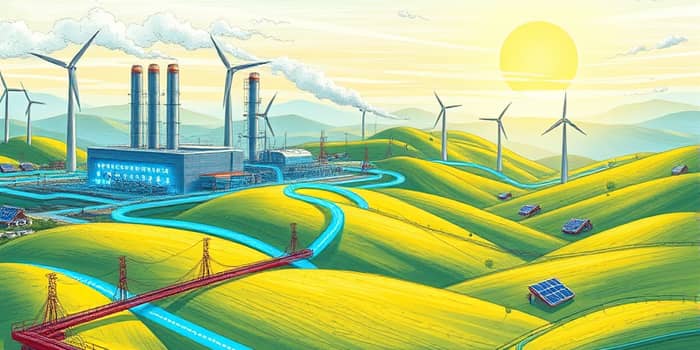
As the world races to reduce greenhouse gas emissions and build resilient energy systems, hydrogen emerges as a cornerstone of a new era. From sprawling industrial complexes to remote power plants, this abundant element offering clean energy solutions promises to reshape how we produce, store, and consume power.
By harnessing transform industries and stabilize grids, stakeholders can unlock pathways to hard-to-electrify heavy industrial sectors and enable long-duration renewable energy storage. In this article, we explore the forces driving the hydrogen economy, its technologies, and how businesses and communities can take practical steps toward a vibrant, decarbonized future.
Hydrogen is the simplest and most abundant element in the universe, yet on Earth it rarely exists in its pure form. To tap its potential as an energy carrier, we must produce it from water, hydrocarbons, or biomass and then develop the infrastructure to distribute, store, and use it across sectors.
A true hydrogen economy envisions a major energy carrier alongside electricity, supporting a low-carbon transition. Its four pillars encompass:
Together, these elements form a flexible system capable of integrating renewables, decarbonizing hard-to-electrify sectors, and enhancing energy security.
Global hydrogen demand reached approximately 97 million tonnes in 2023, a modest increase over previous years. While grey hydrogen—produced from natural gas and coal without capturing emissions—still dominates, the appetite for low-emissions variants is surging.
In the United States, strategic roadmaps forecast $140 billion in annual revenue and 700,000 jobs by 2030, scaling to $750 billion and 3.4 million jobs by mid-century.
Hydrogen serves as both a fuel and chemical feedstock, capable of reducing carbon and air pollutants when produced cleanly. It complements direct electrification by addressing:
Major studies emphasize that clean hydrogen must scale rapidly through the 2020s to unlock cost reductions and achieve net-zero targets. By storing green energy in the form of hydrogen, grids can balance variable renewables and bolster resilience against outages.
Hydrogen production methods vary by feedstock, emissions intensity, and capital requirements. Common routes include steam methane reforming (SMR), water electrolysis, coal gasification, and biomass conversion. Industry jargon classifies hydrogen by its “color”:
Among these, green hydrogen—electrolyzed using only renewable energy—carries the highest environmental promise, though current costs remain above fossil routes. Technological improvements and scale-up are driving down electrolyzer prices and boosting efficiency.
Storing hydrogen poses challenges due to its low volumetric energy density. Solutions range from high-pressure tanks and cryogenic liquid to geological caverns. Each option balances capital cost, energy losses, and site suitability.
Building out a robust distribution network—pipelines, fueling stations, and ports—is essential. Blending hydrogen into existing natural gas pipelines can serve as an interim measure while dedicated hydrogen infrastructure expands.
Heavy industry stands to gain immediate benefits from hydrogen’s versatility. Steelmakers are piloting direct reduction of iron ore with hydrogen rather than coal, cutting CO₂ emissions by over 90%. Chemical producers are switching to clean hydrogen for ammonia and methanol synthesis.
Emerging use cases include:
These pilots demonstrate how absorb excess renewable power and channel it into high-value applications, fostering new business models and local jobs.
Strategic government policies and funding are critical to unlock hydrogen’s potential. Effective measures include:
National roadmaps in Europe, Asia, and North America align industry, utilities, and research institutions toward common targets. Public-private partnerships share risks and accelerate technology deployment.
As costs decline and infrastructure scales, hydrogen will become a pillar of a diversified, resilient energy system. Stakeholders—from policymakers to entrepreneurs and community leaders—can take practical steps today:
By embracing hydrogen’s versatility as both feedstock and energy carrier, we can chart a path toward net-zero emissions, new economic opportunities, and a cleaner planet. The hydrogen economy is not a distant dream—it is a tangible roadmap for powering tomorrow’s industries today.
References