Search
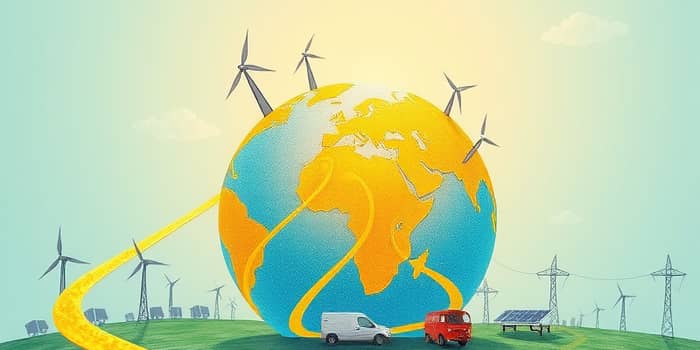
The global shift toward clean energy is not just a technological revolution, it represents an economic metamorphosis on an unprecedented scale. Capital, once tied to fossil fuels, is being rerouted into renewable technologies, creating new opportunities and challenges for investors, policymakers, and societies worldwide.
In 2025, global energy transition investment reached a record $2.3 trillion in 2025, marking an 8% increase from the prior year. This surge reflects a decade-long acceleration, during which annual investments climbed past the $2 trillion threshold, driven by both public initiatives and private commitments.
Despite this growth, estimates suggest that to achieve net-zero emissions by 2050, average annual investment must rise to approximately $3.5 trillion, nearly four times current annual expenditure rates. Under BloombergNEF’s base-case scenario, average annual spending is projected to climb to $2.9 trillion over the next five years—still short of the levels needed to meet Paris Agreement goals.
The investment trajectory underscores a critical reality: meeting global climate targets demands sustained and expanding financial flows. As technologies mature and economies of scale improve, the cost of capital deployment will play a decisive role in determining the pace of decarbonization.
The energy transition spans multiple sectors, each attracting distinct levels of funding. Electrified transport emerged as the largest category in 2025, while renewable energy generation, grid enhancements, and climate-tech innovations also saw significant inflows.
To illustrate the allocation of capital across sectors, the table below summarizes key investment figures for 2025:
This breakdown reveals a landscape in flux: despite a temporary dip in renewable energy funding, sectors such as transport electrification and climate-tech equity are experiencing rapid year-on-year expansion.
The Asia-Pacific region led global investment in 2025, accounting for 47% of total spending. China remained the largest single market with $800 billion invested, even as it saw its first decline in renewable funding since 2013.
The European Union expanded its investment by 18% to $455 billion, while the United States achieved a 3.5% increase to $378 billion despite policy headwinds. India also recorded a robust 15% growth, reaching $68 billion in clean energy capital deployment.
However, a striking misalignment persists: over 80% of incremental energy demand is concentrated in emerging and developing economies, yet they receive under 10% of global clean energy investment. Addressing this disparity is essential for equitable and effective decarbonization.
Investment in the energy transition is no longer perceived as a short-term trend but as a multi-decade capital deployment cycle underpinned by robust structural forces. These drivers shape market behavior and inform strategic decisions across sectors.
These factors combine to create a landscape where energy-transition investing is evolving from a sustainability narrative into a central pillar of institutional capital allocation.
Much of the financing for this global shift originates in private markets rather than public equity. Infrastructure funds, private equity vehicles, and private credit strategies are at the forefront, channeling capital into projects that drive renewable deployment and industrial decarbonization.
This shift highlights the growing influence of private capital in steering the transition and underscores the importance of innovative finance mechanisms to bridge investment gaps.
Despite global policy volatility and geopolitical tensions, energy transition funding has proven resilient. In the United States, investment rose even amid regulatory uncertainty, while trade disruptions and supply chain challenges have had only marginal impacts on long-term deployment plans.
Governments are increasingly mobilizing private capital through risk-sharing, loan guarantees, and blended finance. Yet challenges remain: changing regulations in key markets have led to funding pullbacks, and reliance on subsidies, though reduced, persists in certain segments.
Balancing policy certainty with innovation-friendly regulation is critical to sustaining investor confidence and accelerating the pace of capital deployment.
The global energy transition represents one of the largest capital reallocation events in modern economic history. Unlike traditional infrastructure booms, it is driven by long-term climate commitments, technological innovation, and shifting geopolitical dynamics.
Investors are repositioning portfolios as energy-transition assets move from the periphery to the core of infrastructure allocations. Record fundraising for transition-focused funds suggests enduring conviction in the sector’s growth prospects.
Looking ahead, sustained declines in technology costs, growing electricity demand, and urgent energy security concerns point toward continued and expanding capital deployments for decades to come.
The 2025 Energy Transition Index shows that 65% of countries improved their overall performance, with 28% advancing across all core dimensions of security, sustainability, and equity. This marks the fastest rate of progress observed since before the COVID-19 pandemic.
Nordic countries top the rankings, while emerging Europe and Asia achieve significant year-on-year gains. These metrics underscore both the strides made and the work that remains to ensure a just and inclusive transition.
Developing resilient, onshore clean energy supply chains is critical. Investment in battery production, critical minerals processing, and clean-tech manufacturing is rising, though concerns about capacity and alignment with net-zero pathways remain.
Strengthening domestic manufacturing and diversifying supply sources will be essential to meet the ambitions of a net-zero future.
In conclusion, the energy transition is reshaping capital flows on a global scale. Achieving the necessary investment trajectory requires concerted action from governments, financial institutions, and private enterprises. By aligning policy frameworks, unlocking private finance, and addressing geographic imbalances, stakeholders can ensure that the transition delivers both environmental and economic dividends for communities worldwide.
References