Search
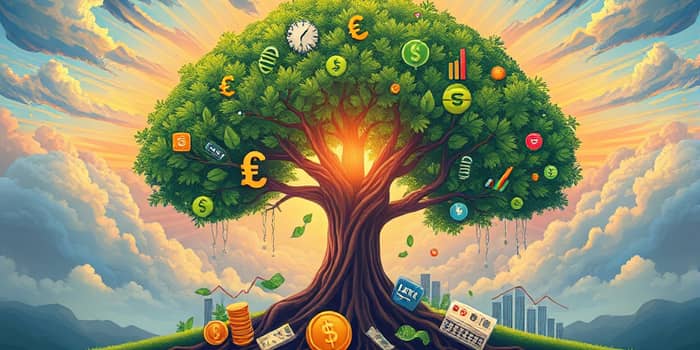
In an era of rapid market swings and economic uncertainty, investors seek strategies that endure. The concept of an "Evergreen Portfolio" offers a powerful framework designed to navigate cycles without sacrificing growth.
An "Evergreen Portfolio" is more than a collection of assets—it is structured to thrive through volatility and designed for perpetual growth. Originating in both public and private markets, this philosophy emphasizes long-term compounding, disciplined risk management, and continuous exposure to high-quality opportunities.
Across contexts, "evergreen" can refer to:
By unifying these senses, investors gain a holistic framework that balances offense and defense, seizes opportunities in downturns, and preserves capital during peaks.
Markets move in recurring phases, each presenting unique risks and rewards. Recognizing these stages allows an evergreen portfolio to adapt dynamically rather than react emotionally.
In public markets, bull and bear cycles mirror these stages, influencing sector leadership and investor behavior. Private markets follow a similar four-phase pattern, shaping deal flow, fundraising, and exit timing.
Successful evergreen investors embrace traits that transcend market noise:
By staying invested yet adapting the asset mix, these behaviors harness the full spectrum of cycle-driven opportunities and mitigate downside risks.
Evergreen structures in private equity and credit have proliferated in recent years. Unlike traditional closed-end vehicles with fixed 10–12 year lives, evergreen funds offer:
continuous exposure and vintage diversification through ongoing capital deployment and reinvestment of distributions, paired with semi-liquid redemption windows and portfolio stability.
Key structural features include:
These attributes impart several advantages over closed-end peers:
Data suggests that evergreen funds outperform closed-end structures on a risk-adjusted basis over rolling one- and three-year windows, thanks to their pacing and diversification.
Building an evergreen portfolio—whether through public assets, private vehicles, or a hybrid approach—requires intentional design:
Combining offensive and defensive positions allows the portfolio to capture growth in upcycles while preserving capital during downturns. Over time, disciplined reinvestment and vintage diversification smooth volatility and enhance compounding.
Consider a multimanager evergreen fund that allocates across buyout, growth equity, secondaries, and private credit. By deploying capital continuously:
– During contractions, it picks up discounted assets and special situations.
– In expansions, it participates in high-growth, early-stage opportunities without overstretching valuations.
At the same time, quarterly redemption gates and subscription windows ensure that liquidity is managed sustainably, preventing forced wholesale exits at market troughs.
Evergreen portfolios carry distinct challenges:
Valuation transparency can lag, requiring robust governance. Managers must maintain sophisticated pricing policies to reflect true asset values.
Liquidity mismatches can arise if inflows outpace deployment or redemptions accelerate during stress. Well-capitalized platforms and conservative redemption gates help align liquidity with underlying investments.
Finally, concentration risks in niche strategies may warrant additional oversight. A clear mandate for manager diversification and co-investment structures can mitigate single-manager or single-asset exposure.
An Evergreen Portfolio is ultimately an investment mindset—one that rejects market timing and embraces long-term compounding and prudent risk management. By designing portfolios to endure cycles, investors can ride out volatility while capitalizing on the asymmetric upside that markets offer over decades.
Whether through public markets with tactical sector rotation or via private market evergreen funds, the goal remains constant: build a resilient engine that powers your financial future, regardless of where we stand in the cycle. Start small, scale deliberately, and commit to a process that prioritizes sustainability over short-term gain.
In doing so, you create your own evergreen—one that persists, thrives, and bears fruit across every twist and turn of the market’s journey.
References