Search
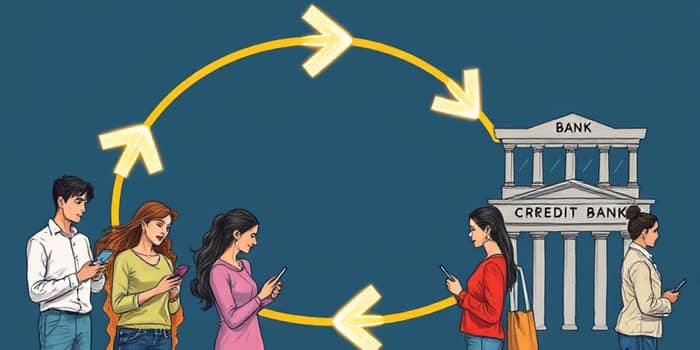
Every time a lender decides who receives credit, sets interest rates, or defines repayment schedules, that choice ripples through borrowers’ lives and the broader financial ecosystem. These decisions do not stand alone; they shape future borrowing, risk perceptions, and the very data that underpins the next round of underwriting.
In this article, we explore the many facets of the credit feedback loop—how approval, denial, pricing, technology, and human biases combine in a dynamic cycle of credit outcomes that can either lift consumers toward financial stability or push them into deeper distress.
At its core, a credit feedback loop describes how each lending decision influences borrower behavior and future credit access. Positive experiences can reinforce trust and responsible habits, while negative shocks often trigger higher risk and tighter terms in a positive and negative feedback loops framework.
These loops unfold at both the individual and macro levels. For households, one missed payment can elevate costs and stress; for economies, shocks to employment or asset values can cascade through banking systems, leading to credit contraction and further downturns.
Lenders’ approvals, denials, and pricing serve as powerful signals. An offer with a high limit and low rate may boost confidence, whereas a low limit or high interest can be read as a warning. These signals interact with individual psychology to create a perceived creditworthiness and borrowing incentives dynamic.
Loan characteristics—interest rate, fees, penalty structures, and repayment schedule—further shape conduct. For instance, shorter repayment schedules induce stress when borrowers juggle volatile incomes, sometimes leading to rollovers and spiraling balances.
Traditional credit scores aggregate payment history and credit utilization patterns into a single metric that heavily influences decisions. Every new account, limit change, or late payment feeds back into the model, creating tiers of pricing that often mirror socio-economic divides.
Today’s AI and machine learning models promise finer-grained risk assessments but risk perpetuating past inequities. Historical data may encode biases—under-lending to certain communities—that become historical discrimination perpetuated by models. The result is a self-fulfilling prophecy of exclusion.
Economic cycles compound these effects. Rising defaults prompt lenders to tighten standards, raise rates, or withdraw offers. This contraction then strains more borrowers, triggering additional defaults and a macro-level credit contraction impacts cycle that echoes the household-level loops.
The degree of automation in underwriting ranges from fully algorithmic to hybrid systems with human oversight. Incorporating a manual review for borderline cases can inject fairness and break harmful chains of automated declines, but it introduces potential inconsistency and slower decision timelines.
Fintech platforms have revolutionized small business and consumer lending by tapping into non-traditional data sources for underwriting—from e-commerce receipts to mobile payment histories. Lower origination costs have expanded access, yet inaccurate risk pricing can lead to waves of defaults that restore a new circle of exclusion.
Borrowers often fall prey to present bias, overvaluing immediate consumption at the expense of future obligations. This overvaluing immediate consumption and obligations makes “buy now, pay later” schemes particularly enticing and risky.
Lenders, too, harbor biases. Anchoring on credit scores can blind institutions to alternative indicators of stability. An excessive reliance on credit scores crowds out innovation in credit assessment and perpetuates disparities, especially for thin-file or historically underserved populations.
“Buy Now, Pay Later” services have grown exponentially by offering frictionless checkout experiences and no-interest installments. While they deliver convenience, BNPL products introduce new feedback loops: early arrears lead to higher default rates and then stricter underwriting or higher fees for entire customer segments.
Understanding these loops is crucial for consumers and regulators alike. Without careful design, digital credit can shift stress from traditional credit cards to juggle multiple installment plans, creating hidden vulnerabilities.
Policymakers are increasingly focused on transparency and the right to explanation. Ensuring explainable and auditable AI decisions can help consumers contest unfair declines and rebuild trust in digital lending platforms.
Robust consumer protections—such as guaranteed appeals processes, caps on penalty fees, and clear disclosures—are essential to prevent predatory cycles that trap vulnerable borrowers.
Lenders and regulators can deploy flexible repayment plans, hardship forbearance, and targeted financial education programs to help borrowers stay current. Offering small, responsible credit-building products can foster stability rather than dependency.
Hybrid underwriting models that combine data-driven risk scores with human empathy and case-by-case review are powerful tools to interrupt vicious cycles and create pathways to better outcomes.
The credit feedback loop is a double-edged sword: it can amplify trust and opportunity or entrench exclusion and stress. Navigating this complex system demands a holistic approach to credit risk that balances automation, human oversight, fairness, and financial health.
By understanding and thoughtfully designing each link in the loop—from pricing and signals to technology and regulation—we can build a credit ecosystem that empowers consumers and sustains economic resilience.
References