Search
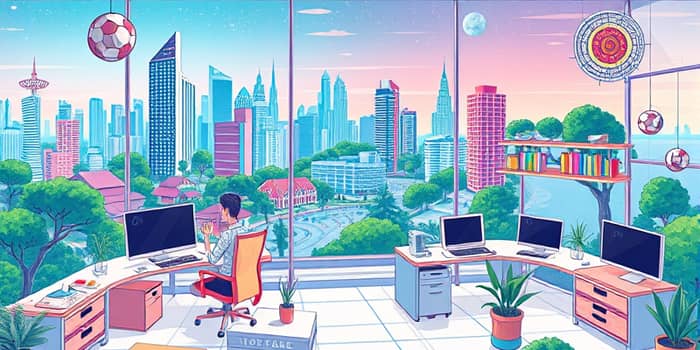
As we stand on the cusp of unprecedented change, work is evolving at lightning speed, reshaping our homes, cities, and skills.
The seismic shift toward flexible schedules and remote options has crystallized into a structured hybrid model that balances office interaction with home-based productivity.
Today, approximately 40% of employees work remotely in some capacity—27% on a hybrid schedule and 12% fully remote—while over 60% have returned to office settings at least part-time. This structured hybrid models as the anchor approach addresses both employer needs for collaboration and individual cravings for autonomy.
Artificial intelligence is no longer a distant promise. It is embedding itself into daily workflows, automating routine tasks and unlocking new creative frontiers.
Only 54% of professionals used AI tools last year, yet those who adopted daily reported higher productivity and job security. Leaders forecast that by 2027 millions of roles will be displaced and created, demanding an ethical and strategic approach to implementation.
Organizations are forming AI governance frameworks and investing heavily in upskilling. With C-suite expectations high but ROI still maturing, the road ahead hinges on balancing innovation with responsibility.
As machines handle data-driven chores, uniquely human abilities gain amplified value. Emotional intelligence, creativity, adaptability and curiosity emerge as decisive differentiators.
Gen Z employees rate these power skills like emotional intelligence as equally vital to technical expertise. Companies are shifting from pure efficiency to empowering individuals, cultivating cultures where resilience and social influence steer performance.
Investing in these capabilities not only fosters engagement—currently only 21% globally—but also future-proofs workforces against automation risks.
Remote and hybrid patterns have sparked a renaissance in how we choose and design our homes. Space is now judged by its versatility as much as its location.
Investors eye homes with adaptable layouts and robust connectivity to minimize vacancies and command premium rents. Local governments respond by upgrading transit and green spaces, bridging the gap between work and lifestyle.
Traditional office towers face leaner days, prompting owners and occupiers to reimagine space as an experience rather than a cubicle farm.
This shift toward reimagining office spaces as collaborative hubs aligns with the 34% of hybrid workers now commuting four days weekly—a figure up from 23% in 2023.
Beyond real estate, the new work paradigm ripples through urban planning, trust in leadership, and personal wellbeing.
Economic activity disperses from central business districts to suburban corridors. A surge in micro-hubs—local cafes and community centers—offers third-spaces for connection. Public transit usage climbs by 8-9 points among hybrid workers, signaling long-term shifts in infrastructure needs.
Organizations recalibrate entry-level roles for AI oversight, while apprenticeships and continuous learning become company cornerstones. Wellbeing initiatives and DEI programs no longer serve as mere bulwarks against burnout—they drive innovation and retention.
Looking forward, several forces will define the trajectory of work and its spatial footprint:
Experts such as Jen Paterno of CoachHub stress that power skills form the foundation of leadership in an AI-augmented world. Frank Weishaupt of Owl Labs warns of “hybrid creep,” where in-office mandates creep upward, underscoring the need for clear expectations.
The convergence of hybrid models, AI integration and human-centric skills is rewriting our concept of work—and, by extension, the spaces we inhabit.
Whether you’re a homeowner, corporate leader or aspiring professional, embracing adaptability, lifelong learning and community-focused design will be your compass in this new era.
The future of work extends far beyond office walls: it beckons us to craft environments—physical and digital—that nurture creativity, connection and growth for all.
References