Search
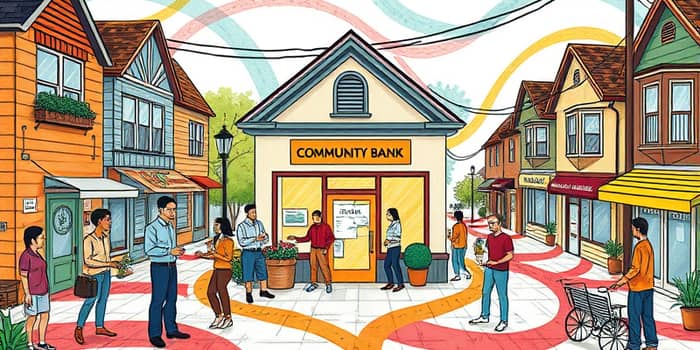
In an era where financial decision-making often seems detached from everyday realities, a deep local market knowledge emerges as a powerful catalyst for growth. Recent studies show that when lenders truly understand neighborhood demographics, employment patterns, and business cycles, they can tailor financing in ways that national players often cannot.
Across the United States and beyond, the closure of bank branches has led to a persistent decline in small business lending—dropping by an average of $453,000 per branch each year. Meanwhile, regions like the Asia-Pacific boast credit market growth rates exceeding 12%, driven by smartphone super-apps and identity platforms that integrate seamlessly with local economies.
Credit unions illustrate how community expertise enhances decision-making. With roots in neighborhoods and a membership ethos, these institutions leverage community-embedded lending practices and insights to support commercial real estate projects, family businesses, and nonprofit ventures. Borrowers value institutions that appreciate their unique circumstances and regional economy, fostering loyalty and sustainable growth.
When credit unions underwrite commercial real estate (CRE), they follow a micro-focused process:
These steps help explain why credit unions deliver informed, flexible lending strategies that support both investor returns and local prosperity.
Banks planning to expand face a critical choice: establish new branches or acquire existing ones. Research reveals that branching strategies deliver superior microeconomic outcomes because they enable access to local information that is otherwise unavailable.
Quantitatively, branching lowered county HHI concentrations significantly—shifting from averages above 4.6% in the late 1990s to near 0.1% by 2012 in sample regions. Conversely, when large banks closed branches, annual small business originations fell by roughly $453,000, and local employment growth dipped by two percentage points.
The United States presents a striking tapestry of credit risk contrasts. Based on recent data from over 8,000 corporates and 40 banks, the Rocky Mountain region ranks highest in corporate default risk, followed closely by the Far West and the Southeast. The Great Lakes states, once manufacturing powerhouses, now show sharp declines in both corporate and financial sector ratings.
At the state level, net downgrade biases exceed 10% in Missouri and Oklahoma, while Hawaii, Rhode Island, and South Dakota report upgrade biases of 13–20%. New England emerges as the most resilient zone, with stable corporate ratings and steady employment trends post-pandemic. These sharp regional contrasts signal opportunities for targeted investment and policy interventions.
Microeconomic insights in U.S. credit markets mirror trends abroad. Consumer credit platforms in Asia-Pacific are growing at over 12% annually, powered by integrated payment apps and digital identity systems that underwrite loans instantly. In North America, mergers between Capital One and Discover, along with cross-border data sharing for immigrant borrowers, reshape access dynamics.
Alongside these growth drivers, markets realign funds between cash, credit, equities, and bonds in response to rate uncertainty, underscoring how local shifts in asset preferences can cascade through global portfolios.
Deliberate support for local branches and community lenders plays a crucial role in providing access to credit that fuels entrepreneurship, housing, and job creation. Policymakers should weigh the benefits of enabling new branch entry against the consolidation pressures of large mergers.
Encouraging labor mobility and local hiring in banking can enhance the information flow that underpins sound credit decisions. Meanwhile, investment in digital identity and open-banking initiatives can bridge gaps in thin-file markets, extending financial inclusion without sacrificing the human touch.
As regional economies diverge, stakeholders must recognize the power of context. Whether assessing a Main Street loan or deploying capital in a growth corridor, understanding the community-embedded lending practices and insights behind each credit decision will determine long-term resilience.
By acknowledging microeconomic realities—from credit union success stories to branch closing impacts—leaders can craft frameworks that balance efficiency with empathy. In doing so, they pave the way for sustainable prosperity, ensuring that every neighborhood—no matter its size—benefits from the lifeblood of responsible credit.
References