Search
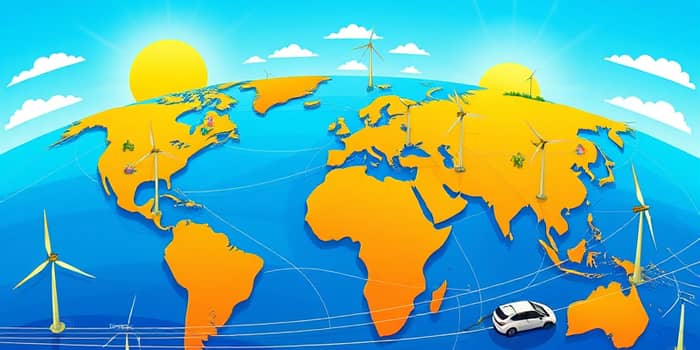
As governments, corporations, and communities unite around the need to decarbonize, we stand at one of the most transformative eras in human history. The convergence of policy, innovation, and finance is unlocking an unprecedented flow of capital toward sustainable solutions. From solar farms stretching across deserts to electric vehicle fleets revolutionizing transport, every sector is adapting to a rapidly evolving energy ecosystem.
In 2025, total global energy investment reached a record US$3.3 trillion, marking a 2% year-on-year increase. Crucially, renewable energy outspending fossil fuels by a ratio of 2:1 demonstrates the momentum behind clean technologies. Within that total, energy transition-specific investments soared to US$2.3 trillion—equivalent to the entire GDP of nations like Italy or Brazil—highlighting the scale of this shift.
According to leading industry forecasts, the energy transition represents a US$3-6 trillion annual investment opportunity over the coming decade. That figure is projected to accumulate between US$130 and US$175 trillion globally by 2060, covering diverse pathways such as electrification, green hydrogen, and carbon capture. To meet climate goals, capital inflows will need to surge from today’s 2.4% to at least 4% of global GDP, bridging critical gaps in infrastructure and technology deployment.
Projections indicate that annual capital expenditures could exceed US$3.8 trillion by 2030, with an average investment growth rate of 25% through 2030 despite potential slowdowns in certain regions. To contextualize these amounts, consider that annual clean energy investment alone in H1 2025 reached US$386 billion—10% higher than the previous year—spurred by record offshore wind allocations and expanding small-scale solar installations.
Advancements in energy storage are reshaping cost dynamics, with battery prices halving in just two years and declining more than threefold over three years. Today, over 90% of new renewable capacity is more cost-effective than fossil generation, while global renewables capacity reached 4,300 GW by the end of 2024, with solar accounting for more than 60% of new additions.
Investment concentration is heavily skewed toward a handful of powerhouses. China, the EU, and the United States together command roughly 70% of global transition capital through 2040. China alone is set to capture between 30% and 44% of global capital expenditures, underpinned by its dominant cleantech manufacturing and heavy policy support.
Energy Evolution base case ~2.6°C trajectory: Gradual renewable scale-up led by established markets, building on existing infrastructure and moderate policy support.
Energy Dominance delayed action ~3.1°C outcome: Continued reliance on fossil fuels with insufficient clean deployment, leading to higher emissions and climate risk.
Energy Resilience pledges aligned ~2.0°C scenario: Moderate progress aligned with current commitments, improving but not fully closing the emissions gap.
Energy Innovation net zero ~1.5°C ambition: Aggressive electrification and infrastructure investment, with half of all capex devoted to grids and charging networks.
Closing the emissions gap will demand prioritizing grid modernization, EV charging networks, green hydrogen hubs, and large-scale carbon capture and storage facilities. Despite widespread ambition, spending remains below required levels, particularly in transmission and distribution networks where investment is most critical.
Additional growth drivers include scaled-up sustainable aviation fuel plants—expected to reach 42 MMt by 2030—and the integration of AI in grid management. Meanwhile, companies with strong sustainability credentials enjoy lower capital costs, reinforcing the business case for green strategies.
Success will hinge on aligning financial flows with policy frameworks that reward low-carbon outcomes, ensuring that capital not only flows at scale but flows to the right places at the right time.
The energy transition is no longer a distant aspiration—it is an active, trillion-dollar market driving global innovation and growth. By recognizing the scale of opportunity, prioritizing underfunded sectors, and fostering cross-border collaboration, stakeholders can unlock the full potential of a decarbonized future. Every dollar invested today shapes the world of tomorrow, empowering societies to thrive while safeguarding our planet.
As we embark on the next chapter of this journey, the collective actions of investors, policymakers, and communities will determine whether we achieve a just, resilient, and prosperous energy system for all.
References