Search
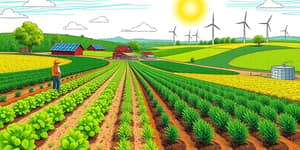
Humanity stands at a crossroads. As the global population surges toward 9.3 billion by 2050, our capacity to nourish every individual depends on a seismic shift in how we cultivate, process, and distribute food. Combining inspiration, data-driven solutions, and strategic investment, agricultural innovation can secure a future of abundance and environmental stewardship.
Traditional farming practices alone cannot meet the projected need for 60 percent more food production while preserving dwindling natural resources. Climate change, soil degradation, and water scarcity compound the challenge, threatening global food security and livelihoods.
Yet history shows that purposeful research and development delivers extraordinary returns: for every dollar invested in agricultural R&D, the world gains nearly twentyfold economic benefits. By harnessing an unprecedented convergence of technology and ecological science, we can achieve resilient systems that nourish all people and protect the planet.
Public and private funding flows underpin progress. In 2016, global public agricultural R&D reached $47 billion, under one percent of agricultural GDP. Meanwhile, Global South innovation saw $60 billion annually (2010–2019), representing 4.5 percent of output. Governments in China, India, and Brazil drive two-thirds of that total, supported by corporate R&D and venture capital.
Despite impressive momentum, investment remains lopsided: high-income nations supply over 60 percent of R&D funding, while low-income regions receive barely two percent. To unlock the full potential of innovation, equity in funding and knowledge transfer must accelerate across continents.
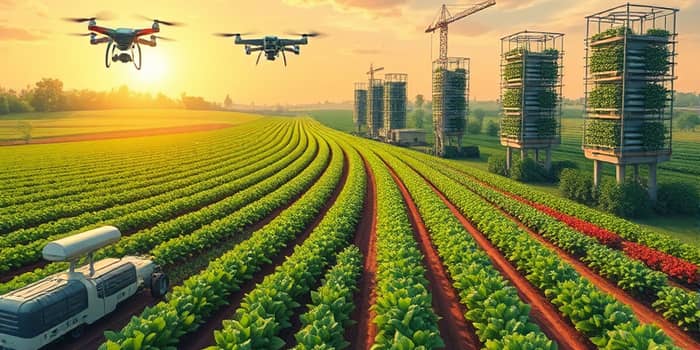
Innovation unfolds across multiple fronts. From regenerative soil health to AI-powered decision-making, these trends promise to transform every stage of the food system.
Looking ahead to 2025–2034, synthetic biology will yield custom crops with enhanced resilience and nutrients, while precision livestock feeding and disease management optimize animal welfare. Together, these innovations can sustain rising demand without overtaxing the Earth.
Barriers remain formidable. Uneven funding, regulatory hurdles, and public skepticism toward biotechnology can stall breakthroughs. Declining public investment in key markets risks stagnating total factor productivity, endangering food security gains achieved over the past six decades.
Yet the business case for investment is compelling. Efficiency gains and cost savings flow from data-driven operations, while new revenue streams emerge from carbon markets, waste valorization, and premium personalized foods. Over 400 emerging innovations boost on-farm productivity today, with economics improving as digital platforms confer market power to producers.
The future of food demands collective ambition. Governments, investors, startups, researchers, and farmers must unite behind inclusive, data-driven strategies that amplify impact. Policies should incentivize regenerative practices, fund high-priority R&D, and foster global partnerships for climate resilience.
Investors can accelerate progress by channeling capital into scalable platforms, precision tools, and alternative protein ventures. Researchers can prioritize open-access innovation to ensure breakthroughs reach smallholder farms. Entrepreneurs can bridge gaps between laboratory advances and real-world applications, creating solutions tailored to local contexts.
By embracing a holistic vision—one that marries technology with ecological wisdom, equity with economic returns—we can build a food system capable of nourishing every person, preserving biodiversity, and restoring the planet. The opportunity is vast, the need is urgent, and the time to act is now.
Join the movement to invest in agricultural innovation. Together, we can cultivate a future in which thriving communities enjoy abundant, sustainable, and nutritious food for generations to come.
References