Search
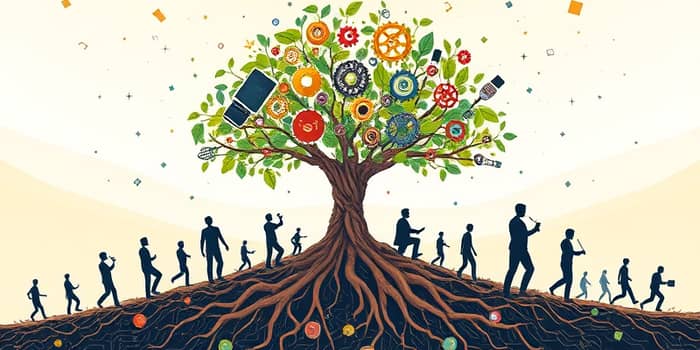
In a world driven by numbers and rankings, it’s easy to overlook the subtle forces that truly propel growth—well-being, trust, real-world impact. This article explores why traditional benchmarks often miss the mark, and how organizations can embrace new frameworks that nurture both people and systems.
For decades, performance has been boiled down to annual ratings, BLEU and ROUGE scores, and generic business metrics. Yet these measurements suffer from recency bias in annual reviews and ignore sustained contributions. Adobe and GE spent over 40,000 manager hours on reviews each year with negligible performance gains. Worse still, chronic stress from episodic evaluations costs the U.S. healthcare system $190 billion annually.
In AI, outdated metrics like BLEU and ROUGE assess fluency but fail to capture factuality, compliance or user alignment. The result is a glaring reliability gap when deploying large language models in real-world settings. Similarly, SaaS businesses often rely on generic CAC and MRR figures that mask the unique needs of different customer segments.
It’s no wonder that more than one third of U.S. companies have abandoned conventional performance reviews. As one HR leader put it, “Your brain’s neuroplasticity thrives on frequent, specific feedback—not the cognitive overload of processing twelve months of data at once.”
High-performing organizations are shifting to shift from episodic to continuous assessment, ensuring employees receive timely recognition and coaching. Groundbreaking examples include Microsoft, whose “feedforward” conversations drove a 10 percent increase in engagement in year one, and Adobe, which saw a 30 percent engagement boost after eliminating forced ratings.
Companies that prioritize people performance are 4.2 times more likely to outperform peers, achieving 30 percent faster revenue growth. By focusing on both achievement and well-being—sleep, exercise, stress management—organizations create sustainable cultures where individuals can thrive.
Even the most sophisticated AI systems falter when judged solely by traditional benchmarks. Enterprises now adopt custom metrics for enterprise-scale LLMs, evaluating models on domain-specific compliance, user alignment, and risk mitigation. Continuous learning from human feedback and rapid iteration ensure that solutions remain reliable and trustworthy.
In the SaaS world, data from Benchmarkit’s 2025 report shows that companies targeting the right customer segments reduce acquisition costs by 20 percent and accelerate expansion by tailoring metrics around retention, churn, and upsell rates. This nuanced approach transforms raw figures into actionable insights.
Implementation follows clear principles: frequent, specific check-ins that calm the amygdala; agile goals that leverage neuroplasticity thrives on frequent input; and leadership coaching that emphasizes learning over judgment. Embedding these practices across HR, AI, and business units drives measurable gains and fosters trust.
The shift is straightforward: stop chasing abstract scores and start measuring what truly matters to your people, your customers, and your mission. As one AI leader put it, “Closing the GenAI confidence gap isn’t about chasing perfect metrics—it’s about defining the right ones.” By adopting people-first performance approaches drive growth, organizations can unlock untapped potential, elevate well-being, and deliver real-world impact.
References