Search
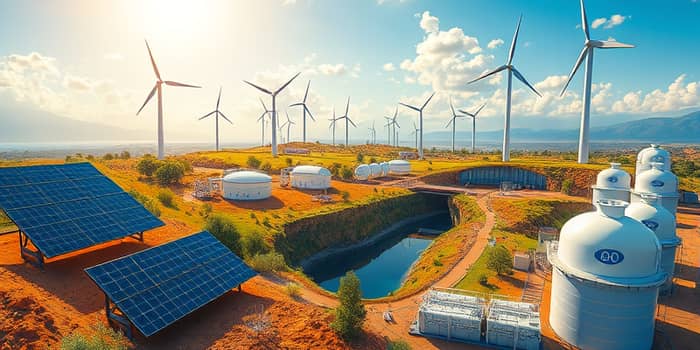
The global shift towards renewable energy has accelerated in recent years, driven by urgent climate goals and technological breakthroughs. Yet solar and wind power present a fundamental challenge: their output fluctuates with weather patterns and time of day. Bridging this gap requires robust energy storage solutions that capture surplus generation and deploy it when demand surges.
Energy storage is more than a supporting technology—it is the backbone of a resilient, zero-carbon electricity system. By storing electrons rather than burning fuel, we can transform intermittent renewables into a dependable power source. This article explores the breadth of storage options, from batteries to hydrogen, and outlines how they will shape a sustainable future.
At its core, energy storage bridges the supply-demand mismatch inherent in renewable generation. Instead of curtailing excess wind or solar output, storage systems hold that energy in reserve. When clouds gather or the wind dies down, stored power can be dispatched to maintain the integrity of the grid.
This flexibility delivers a suite of benefits. It reduces price volatility by enabling strategic load shifting and peak shaving, bolsters grid resilience during outages, and supports ambitious decarbonisation targets. A secure and stable electricity network also mitigates geopolitical risks and safeguards communities from fuel price shocks.
Global storage capacity is expanding rapidly. BloombergNEF estimates that by the end of 2023, installations reached almost 2 terawatt-hours. Meanwhile, thermal storage is projected to triple by 2030, demonstrating that the world is mobilizing to solve the variability problem once and for all.
Not all storage technologies are created equal. Different applications demand distinct performance characteristics, durations, and scales. Industry experts classify storage into five primary categories:
Each category addresses storage needs across timescales from milliseconds to months. The following table highlights key technologies, their typical durations, and common applications.
Lithium-ion batteries dominate the current market, thanks to their high energy density and rapid response time. They excel at short-duration tasks like frequency regulation, voltage support, and peak shaving. Residential solar-plus-storage systems and electric vehicles are further driving economies of scale and cost reductions.
However, li-ion chemistry faces limitations when deployed at multi-day or seasonal scales. Safety is a paramount concern: thermal runaway and fire risk demand rigorous design standards and real-time monitoring. Material supply chains reliant on lithium, cobalt, and nickel also face geopolitical and environmental pressures.
To address these challenges, flow batteries, sodium-ion, solid-state, and metal-air chemistries are emerging. Flow batteries, for example, store energy in external electrolyte tanks, enabling independent scaling of power and capacity. While upfront costs are higher, their long cycle life and deep discharge capability make them promising for longer-duration grid services.
As costs decline and recycling processes improve, a portfolio of electrochemical options will coexist, each optimized for specific use cases and durations.
Pumped-storage hydropower remains the world’s most mature and largest-scale storage technology. By moving water between reservoirs at different elevations, it offers storage durations from hours to days with multi-decade lifespans and low operating expenses. Nonetheless, its viability hinges on suitable topography and environmental permitting.
Compressed air energy storage (CAES) and flywheels also play critical roles. CAES systems store pressurized air in underground caverns and release it through turbines when needed, providing several hours of dispatchable power. Flywheels store kinetic energy in a spinning rotor, delivering high-power, rapid-response support ideal for grid stability and contingency reserves.
Thermal storage captures excess electricity as heat or cold, later releasing it for power generation or heating and cooling services. It is particularly valuable for decarbonizing industrial processes and district energy systems.
With global initiatives targeting low-carbon heating, thermal storage capacity is set to triple by 2030. Innovations like pumped heat electrical storage further blur the line between thermal and electric solutions, enabling energy to flow seamlessly between heat and power networks.
Green hydrogen, produced via water electrolysis using renewable electricity, offers long-duration seasonal energy storage and a versatile energy carrier. Surplus power can be converted into hydrogen, stored in tanks or underground caverns, and later converted back to electricity or used as a zero-carbon fuel in industry, transport, and heating.
Power-to-gas pathways integrate renewables into sectors that are hard to electrify directly. While round-trip efficiencies are lower than batteries, hydrogen’s high energy density by mass and volume makes it indispensable for heavy industries, ammonia production, and long-haul transport.
Other synthetic fuels and e-fuels follow similar principles, providing carbon-neutral alternatives that can leverage existing infrastructure and storage assets.
Achieving a fully decarbonized power system requires more than deploying renewables—it demands a diverse, integrated portfolio of energy storage solutions. By matching technology capabilities to duration and application, we can ensure reliable, affordable, and clean power at all times.
Policy frameworks such as capacity markets, tax incentives, and grid-code reforms are crucial to unlocking investment and innovation. International cooperation on supply chains, standards, and research will accelerate next-generation storage breakthroughs.
In communities around the world, from remote microgrids to sprawling urban centers, storage technologies are already delivering value. As costs continue to decline and deployment scales up, these systems will underpin a new era of energy independence and environmental stewardship.
The road to a green future is paved with electrons stored for tomorrow’s needs. By embracing the full spectrum of storage technologies, we can light our cities, power our industries, and heat our homes—all while safeguarding the planet for generations to come.
References