Search
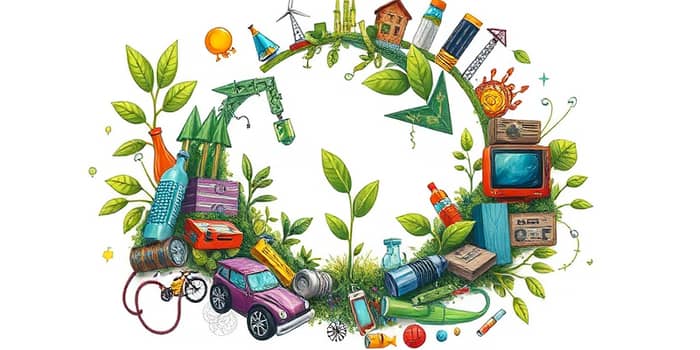
The age of single-use consumption is giving way to a new paradigm. In this vision, products, materials, and natural systems form an unbroken loop of value and renewal. By design, waste ceases to be an unavoidable by-product. Instead, every output becomes a resource for another purpose, regenerating both economy and ecology.
For centuries, our societies have operated on a linear model of “take, make, dispose.” This approach extracts finite resources, transforms them into goods, and discards them once their immediate use ends. The result is mounting waste, pollution, and ecological strain. A circular economy proposes an alternative: materials are kept in circulation, and waste is treated as a design flaw, not an afterthought.
By embracing a systems-level alternative to the linear approach, businesses, governments, and communities can decouple growth from resource depletion. Circularity reframes value around longevity, service-based offerings, and continuous material recovery, creating resilience against supply shocks and environmental harm.
Waste and pollution stem largely from products and systems designed without their end-of-life in mind. If materials are selected and configured for durability, disassembly, and recyclability from the outset, unwanted by-products never materialize.
Prevention is paramount: instead of dealing with trash at landfills or incinerators, a circular strategy focuses on prevention before items reach landfills. Recycling alone cannot solve a flawed design. True circularity eliminates waste at the source.
Maintaining functionality and value maximizes the lifespan of products and materials. The circular hierarchy prioritizes reuse and repair over more resource-intensive processes like recycling and recovery.
By adopting such practices, companies realize longer product life cycles, reduce raw material costs, and open new revenue streams while consumers enjoy affordable, high-quality services.
Circularity aims not only to reduce harm but to actively restore ecosystems. Biological materials can be returned to the environment through composting and regenerative farming, rebuilding soil health and biodiversity.
This dimension ensures that human activities become a positive force for nature, fostering regenerative agriculture and composting that nourish the planet’s life-support systems.
Concrete data illustrates the transformative potential of circularity:
These figures underscore the capacity for economic growth through sustainability reforms. Circular strategies reduce greenhouse gas emissions, relieve pressure on raw materials, and generate high-quality employment across repair, recycling, and regenerative sectors.
Transitioning from theory to practice requires collaboration among stakeholders. Businesses can innovate with product-as-a-service and leasing models, shifting the incentive from volume sales to performance and durability. Governments can enact ecodesign standards, support right-to-repair legislation, and invest in infrastructure for material recovery.
The European Union’s commitment to a climate-neutral, circular economy by 2050 includes rigorous monitoring across five thematic areas and eleven indicators, tracking progress in production, consumption, innovation, and global resilience. In the United States, the EPA integrates circularity within sustainable materials management, emphasizing lifecycle impact reduction and resource decoupling.
International bodies like UNECE and UNCTAD unify statistical frameworks, promote cross-border cooperation, and champion trade policies that value secondary materials over virgin extraction. Together, these efforts build a fertile environment for circular markets to thrive globally.
The circular economy challenges us to rethink every stage of production and consumption. It invites us to view value as more than a one-time transaction—measuring success by value as long-term usefulness rather than short-term throughput.
By eliminating waste, circulating resources, and regenerating nature, we can design industrial and social systems that are both resilient and restorative. The journey demands innovation, policy support, and collective action, but its rewards—a thriving economy within a healthy planet—are within reach.
Embracing circular principles today lays the foundation for a future defined by resilient and regenerative systems, ensuring well-being for generations to come.
References