Search
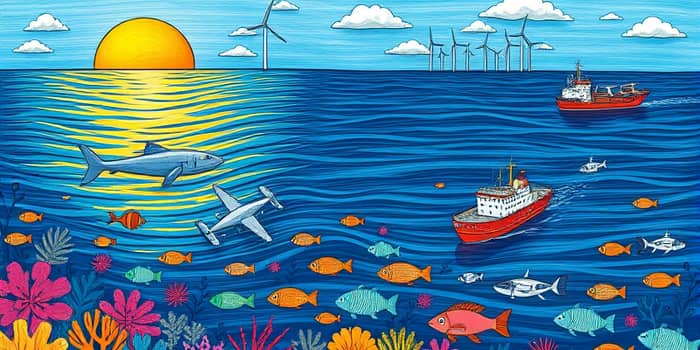
From bustling ports to remote research vessels, the ocean has emerged as a trillion-dollar strategic growth frontier—a realm of food, energy, transport and innovation.
Yet this immense promise hinges on our ability to balance economic growth and climate resilience while preserving marine ecosystems. Across coastal communities, boardrooms and research labs, stakeholders are crafting solutions that unite finance, governance and cutting-edge technology.
The term “ocean economy” encompasses all economic activities tied to oceans, seas and coastal zones. In many definitions it even extends to the Great Lakes. Industries range from time-honored pursuits like fishing to frontier fields such as seabed minerals and marine biotechnology.
Within policy circles, “blue economy” often denotes a preserving ocean health and supporting social equity ethos—using marine resources responsibly to foster prosperity and resilience.
Key sectors include:
Global assessments place the current ocean economy at roughly USD 1.5 trillion. By 2030, it could swell to over USD 3 trillion, driven by rising demand for marine food, energy and sustainable transport.
In the United States alone, the marine economy contributed USD 511 billion to GDP in 2023—equivalent to 1.8% of national output—with 2.6 million jobs and USD 826.6 billion in gross sales. That represented 2.9% GDP growth and 3.5% sales growth year-on-year, underscoring robust momentum.
Several interlinked forces are propelling ocean industries forward:
Trade in ocean goods reached USD 899 billion in 2023, while services topped USD 1.3 trillion, reflecting record‐high demand for seaborne commerce. More than three billion people rely on marine foods, and fisheries alone sustain 600 million livelihoods.
Among emerging sectors, marine energy stands out. Advances in tidal, wave and ocean thermal power hint at a transition beyond niche deployments.
The United States has a theoretical resource of 2,300 terawatt-hours per year—enough for roughly 56% of current electricity generation. Tidal currents in Cook Inlet, Alaska, and Long Island Sound, New York, offer particularly high resource density.
With predictable cycles, tidal power can provide predictable and reliable baseload power to complement wind and solar.
Technology readiness varies: tidal systems are increasingly mature, wave converters remain in pilot stages, and ocean thermal energy conversion (OTEC) awaits commercial viability.
Robust test facilities—with grid connections, long-duration trials and verified performance data—are essential to de-risk permitting and spur investment. These platforms also benefit related fields like underwater robotics, environmental monitoring and critical minerals research.
Despite brisk growth, the ocean economy faces mounting threats. Climate change drives warming waters, acidification and sea-level rise, while pollution and overfishing strain ecosystems.
Ocean industries generate approximately 11% of global CO2 emissions. Shipping alone accounts for 2.9% of the world’s greenhouse gases, with decarbonization costs ranging from USD 8 billion to USD 28 billion annually.
Coastal tourism adds another 4% to global emissions. More than USD 8 trillion in marine-exposed assets are at risk from storms, inundation and erosion—underscoring the pressing need for resilient strategies.
Current investment in sustainable marine activities falls woefully short. In 2022, ocean-related finance totaled under USD 3 billion—far below the USD 175 billion per year needed to achieve UN Sustainable Development Goal 14.
Since 2010, only USD 30 billion has been dedicated to critical ocean initiatives, while harmful fishing subsidies still exceed USD 22 billion annually.
Bridging this gap demands innovative blended finance models, clear policy frameworks and a shift away from subsidies that undermine long-term ocean health.
Unlocking the full potential of our marine resources requires coordinated action.
Governments must strengthen governance and data transparency, investors should channel capital into sustainable solutions, and innovators need supportive infrastructure for testing and scaling new technologies.
By aligning economic incentives with environmental stewardship, we can forge a resilient blue economy that delivers prosperity, climate resilience and healthy oceans for generations to come.
References