Search
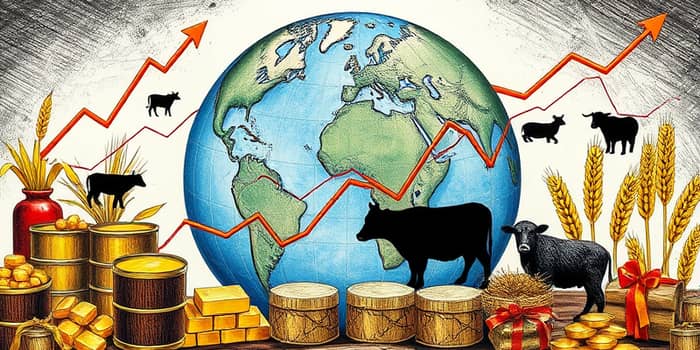
Commodity futures markets function as both mirrors and meters of global economic vitality. By trading contracts that deliver oil, metals, grains, and livestock at future dates, participants embed expectations about inflation, growth, and geopolitical risk into every price tick.
Historically, commodity futures signaled major economic turning points: in 2008 a plunge in crude oil flagged the financial crisis, while in 2020 a pandemic-driven demand collapse sent U.S. oil prices briefly below zero. These events underscore the pervasive influence of global supply-demand dynamics and the critical insights available in futures curves.
Commodities have long served as vital barometers of macroeconomic health. Futures prices lead other financial markets because they incorporate forecasts for consumption, production bottlenecks, and policy shifts months or even years ahead.
By observing shifts across the five major commodity sectors—energy, industrial metals, precious metals, agriculture, and livestock—policy makers and investors gain a window into future economic trajectories. Futures markets become leading indicators of economic trends when price movements reflect confidence or concern before traditional metrics like GDP and employment figures update.
As we enter 2026, analysts present divergent scenarios for commodity prices. Weak global growth and policy uncertainty suggest continued headwinds, while emerging structural deficits and stimulus measures hint at a cyclical resurgence. Navigating these conflicting signals requires a balanced view.
To visualize major price projections for 2026, consider the following summary:
Energy commodities remain at the epicenter of geopolitical risk and economic forecasting. In March 2026, the energy index soared 41.6%, led by natural gas’s 59.4% jump and crude oil’s 40.5% rise after conflicts disrupted Middle East exports.
Access through the Strait of Hormuz and Bab el-Mandeb is increasingly precarious. A prolonged closure would intensify the critical shipping disruption in Hormuz and potentially starve markets of one-third of seaborne crude and LNG volumes.
Meanwhile, global oil output exceeds demand growth, creating supply and demand imbalance pressures that weigh on long-term prices. Forecasts vary: UBS expects Brent crude to rebound above $60 in the second half of 2026 as surpluses tighten, while JP Morgan warns of a possible plunge into the low $30s if excess supply persists.
Strategic petroleum reserves are filling rapidly, and commercial storage constraints may cap future price spikes. Yet an underappreciated driver is the rapid buildout of renewable capacity and energy storage, which could gradually reshape demand dynamics.
Amid volatility, accelerating investment in the energy transition shines as a forward-looking bright spot. Global capital flows into wind, solar, hydrogen, and grid modernization projects reached all-time highs in early 2026, underscoring a long-term shift in energy consumption patterns.
Industrial metals like copper and aluminum are essential inputs for electric vehicles, batteries, solar panels, and data centers. Copper consumption growth is forecast at 2.8% annually, with tight mine capacity and multi-year project pipelines limiting near-term expansion.
Aluminum supply is also stretched, as producers face energy cost pressures and logistical bottlenecks. Priced around $11,000 per tonne, copper remains elevated by historical standards, while aluminum premiums reflect premium-grade alloy shortages.
Beyond base metals, battery-specific materials such as lithium, nickel, and cobalt are drawing surging demand. Regulatory incentives and decarbonization targets in China, Europe, and the U.S. will continue to drive robust consumption growth, suggesting a sustained support floor under prices.
After record-breaking rallies in 2025—gold over $5,000 and silver above $100—the precious metals complex has experienced modest profit-taking amid shifting investor focus to energy. Nonetheless, central bank purchases and persistent currency volatility underpin ongoing demand.
Banks forecast gold in a $4,500–$4,700 range for 2026, with upside potential toward $5,000 if real yields remain negative. Silver’s dual role as an industrial metal and store of value supports a case for prices above $65 per ounce.
For portfolios seeking resilience, safe-haven assets during market uncertainty provide crucial diversification benefits, particularly when equities and bonds face increasing valuations and potential policy tightening.
Agricultural markets painted a mixed picture in early 2026. Fertilizer prices jumped over 26% amid supply chain disruptions and export curbs, while beverage and raw material costs drifted sideways. Weather anomalies—from El Niño-driven droughts in South America to unseasonal frosts in Europe—have amplified price swings.
Corn, soy, and wheat harvests will also test global stock levels, as demand from biofuel mandates and emerging markets remains robust. Traders must integrate satellite imagery, crop progress reports, and policy announcements to navigate the seasonal volatility.
Overarching economic and policy forces will dictate commodity trajectories throughout the year. By staying attuned to these macro drivers, market participants can anticipate price inflections and adjust strategies proactively.
Advanced analytics, machine learning models, and blockchain-based trading platforms are revolutionizing commodity futures. Firms employ data-driven strategies and advanced analytics to forecast price patterns, identify dislocations, and optimize hedging programs.
Commodity producers and users increasingly leverage over-the-counter derivatives and exchange-traded funds to tailor exposure. Automated risk controls and scenario analyses help manage margin volatility and ensure supply chain resilience.
Practical steps for investors and corporate treasurers include:
Commodity futures markets offer a profound glimpse into the global economic pulse, translating complex trends into actionable price signals. By blending rigorous analysis with disciplined risk management, stakeholders can harness these markets for diversification, protection, and strategic growth.
As the world navigates shifting energy paradigms, metal shortages, and intricate geopolitical landscapes, futures contracts remain indispensable tools. They empower participants to anticipate change, seize emerging opportunities, and build financial resilience in an ever-evolving global economy.
References